Understanding sleep apnea
What is sleep apnea?
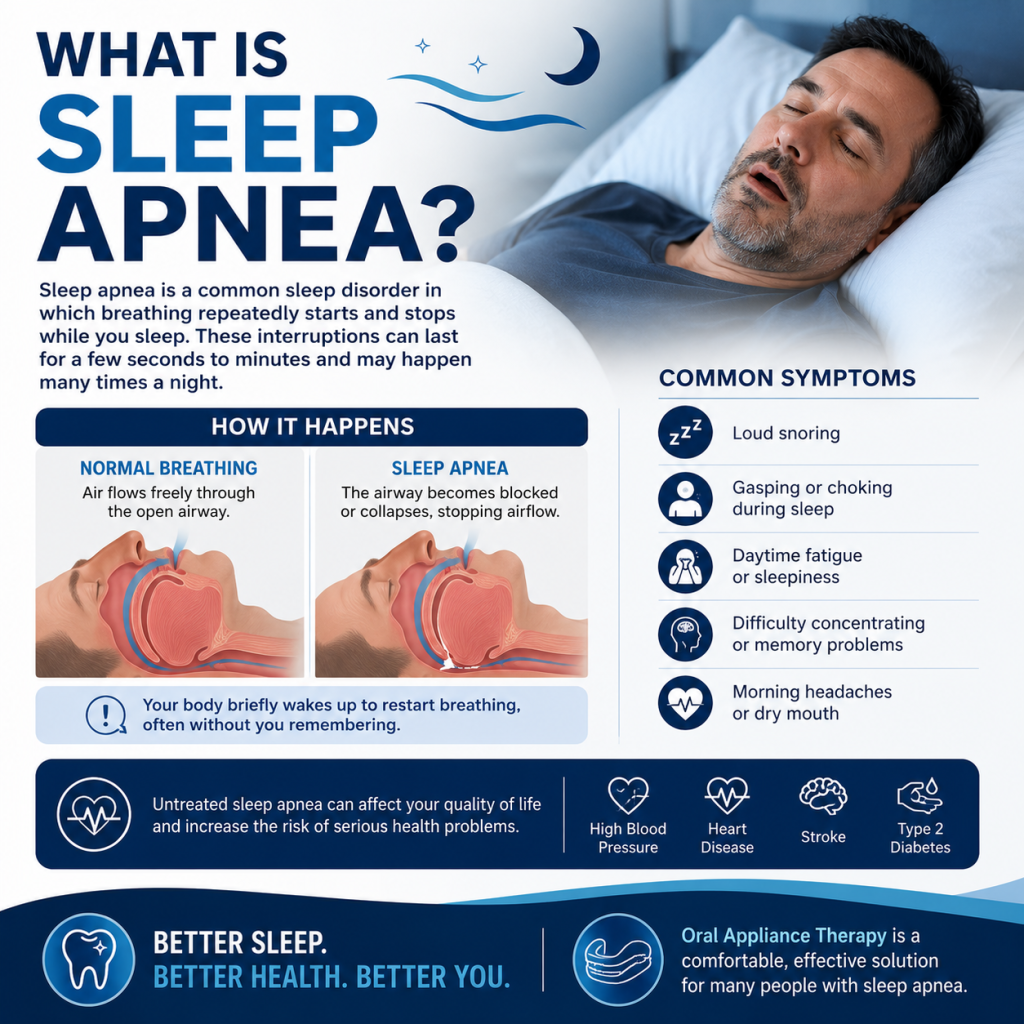
Sleep apnea is a sleep disorder in which your breathing repeatedly stops and restarts while you sleep – sometimes hundreds of times a night – often without you ever fully waking up or knowing it’s happening.
A blocked airway, over and over again
In the most common form – obstructive sleep apnea (OSA) – the muscles at the back of your throat relax too much during sleep. The tongue and soft tissues collapse into the airway, narrowing or completely blocking the path air takes to your lungs.
Each pause in breathing is called an apnea (a complete stop) or a hypopnea (a partial reduction). When oxygen drops, your brain briefly rouses you just enough to reopen the airway – usually with a snort, gasp, or choke – and the cycle begins again.
Because these arousals are so brief, most people with obstructive sleep apnea have no memory of them. What they do notice is the aftermath: exhaustion, brain fog, and a body that never feels rested.
What happens during a single event
Each apnea follows the same cycle – and in moderate to severe OSA, this cycle can repeat 15 to 30 or more times every hour.
Muscles relax
As you fall into deeper sleep, the muscles supporting your tongue and soft palate lose tone and drift backward.
The airway narrows
Airflow becomes turbulent – this is the vibration you hear as snoring – then the airway pinches shut entirely.
Oxygen drops
Breathing stops for 10 seconds or longer. Blood oxygen falls, and your heart and stress hormones surge in response.
The brain jolts you
A micro-arousal snaps the airway open – often with a gasp – and pulls you out of the deep, restorative stages of sleep.
Why you don't remember it
These arousals typically last only seconds – long enough to fragment your sleep, but too short to form a memory. That’s why so many people with sleep apnea insist they “sleep fine” while feeling exhausted every day, and why a bed partner’s observations are so valuable.
Sleep apnea by the numbers
The minimum length of a breathing pause that counts as an apnea event
Of moderate-to-severe obstructive sleep apnea cases are believed to go undiagnosed
Sleep apnea affects men and women of every age and body type – not just older, heavier men
More than a bad night's sleep
Untreated obstructive sleep apnea strains nearly every system in the body. Over time it has been associated with:
Heart & blood pressure
Higher risk of hypertension, irregular heart rhythms, heart attack, and stroke.
Daytime function
Fatigue, poor concentration, memory lapses, and a sharply higher risk of drowsy driving.
Metabolism
Links to insulin resistance, type 2 diabetes, and difficulty managing weight.
Mood & relationships
Irritability and low mood - plus the very real strain loud snoring puts on a partner's sleep.
The encouraging news: obstructive sleep apnea treatment works, and it doesn’t have to mean a CPAP machine. Learn how oral appliance therapy keeps your airway open – comfortably and quietly.
Wondering if this is what's happening to you?
A short consultation at our Washington, PA office can put you on the path to answers – and to nights of real, restorative sleep.