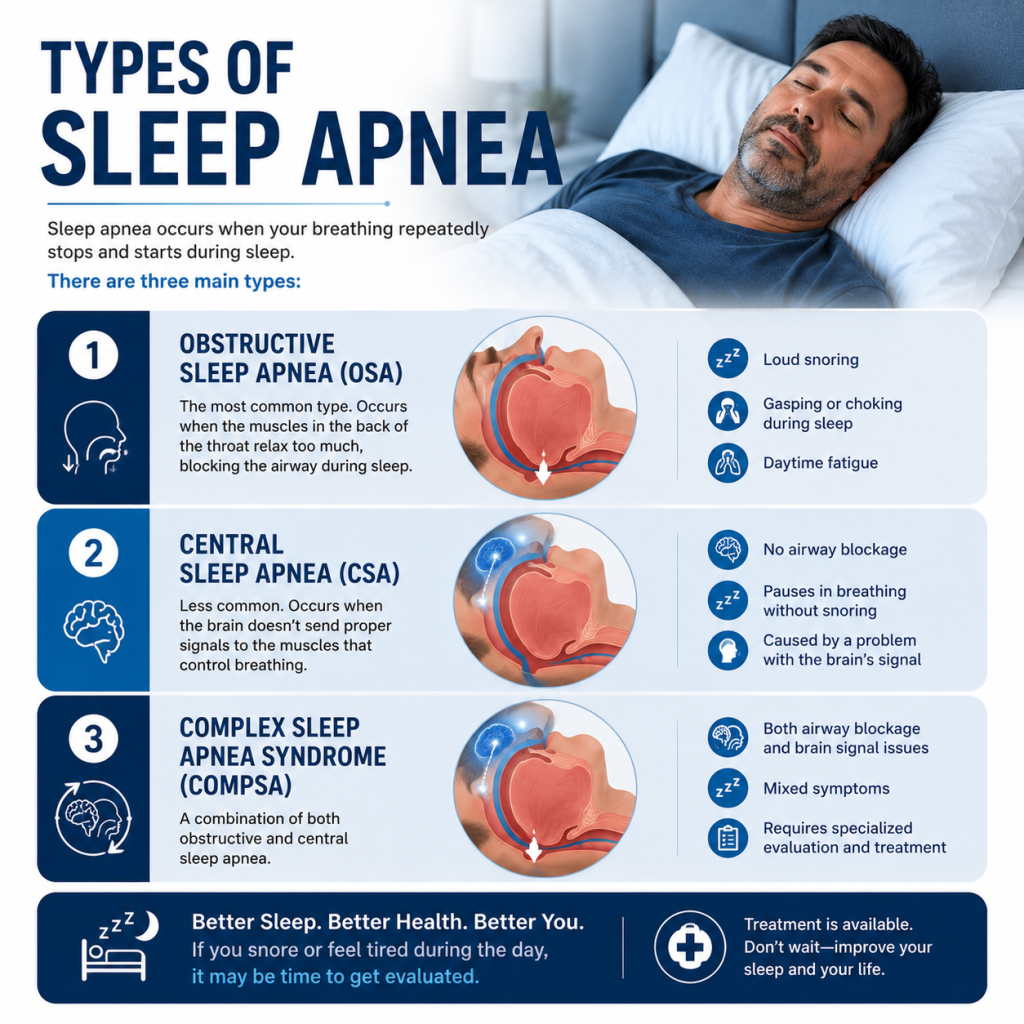
All sleep apnea interrupts breathing during sleep – but why the breathing stops differs. Knowing which type you have shapes which treatments will work, including whether an oral appliance is right for you.
The most common type by far. The brain keeps sending the signal to breathe, but the airway itself collapses – the tongue and soft tissues physically block airflow.
OSA is a mechanical problem, which is why mechanical solutions like oral appliance therapy work: hold the jaw and tongue forward, and the airway stays open.
Central sleep apnea (CSA)
A signaling problem, not a blockage. The brain temporarily fails to send the “breathe” signal to the muscles that control breathing. The airway is open – there’s simply no effort to breathe.
CSA is less common and is often associated with heart conditions, certain medications, or neurological factors. It’s managed medically by a physician.
Complex (mixed) sleep apnea
A combination of both. Complex sleep apnea syndrome describes patients who show central apneas alongside obstructive ones – sometimes emerging during CPAP treatment for OSA.
These cases call for close coordination between your sleep physician and dental sleep provider to find the right combination of therapies.
How severity is measured
Mild, moderate, or severe: the AHI scale
A sleep study measures your Apnea–Hypopnea Index (AHI) – the average number of breathing disruptions per hour of sleep. Your AHI determines your severity level and helps guide treatment choices.
Normal
Fewer than 5
Occasional disruptions are normal; no sleep apnea diagnosis.
Mild
5–14
Noticeable snoring and daytime tiredness are common. Oral appliance therapy is a first-line option.
Moderate
15–29
Breathing is disrupted up to every 2–4 minutes. Oral appliances remain a well-supported treatment, especially for CPAP-intolerant patients.
Severe
30 or more
Breathing is disrupted at least every 2 minutes. CPAP is typically recommended first, with oral appliance therapy as an alternative when CPAP isn’t tolerated.
Severity thresholds are general adult guidelines; your physician interprets your sleep study in the context of your overall health.
Where we fit in
Which types can an oral appliance treat?
Oral appliance therapy is designed for obstructive sleep apnea – the type caused by a physically collapsing airway. It’s a recognized treatment for mild to moderate OSA and for people with more severe OSA who cannot tolerate CPAP therapy.
If your sleep study shows central or complex sleep apnea, we’ll coordinate with your physician on the right medical management. And if you haven’t had a sleep study yet, we’ll help you get one – the diagnosis always comes first.