Treatment
Oral appliance therapy: small device, full night's sleep
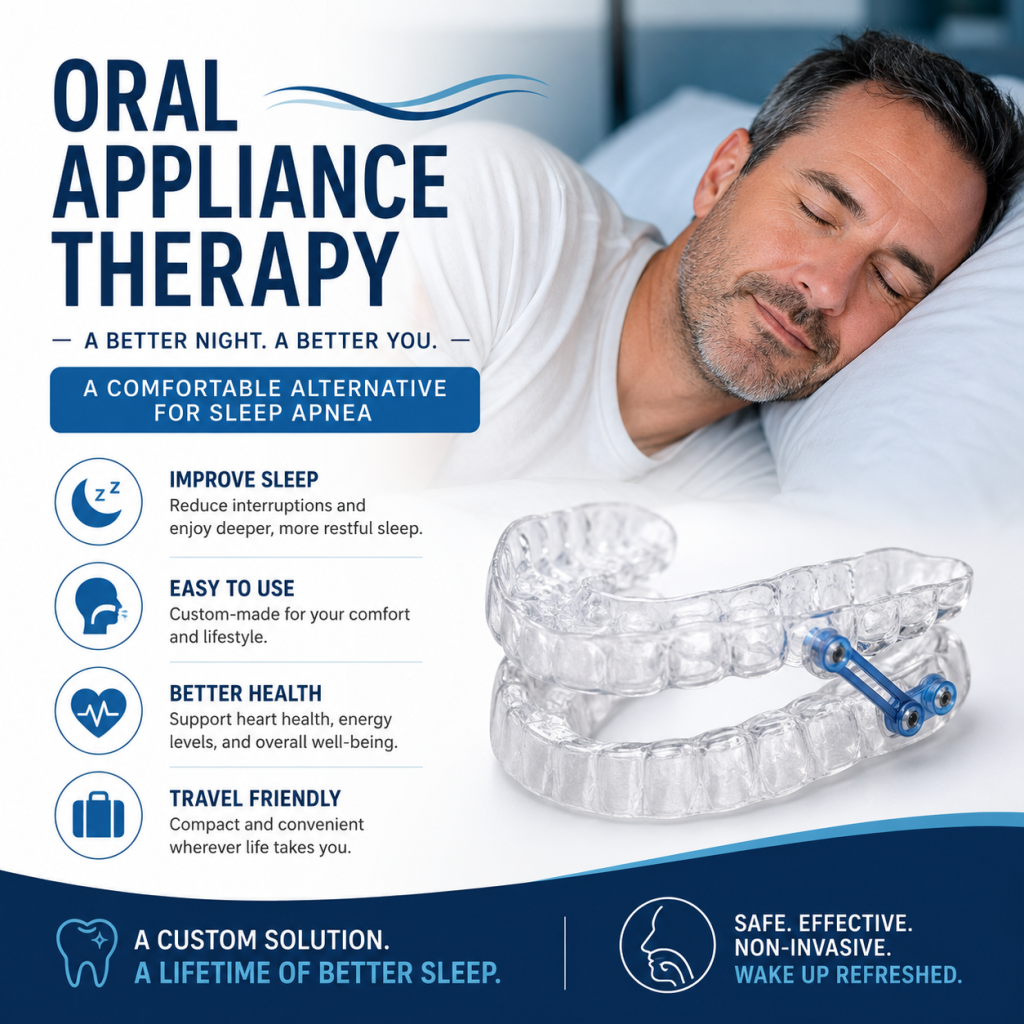
An oral appliance for sleep apnea looks like a slim retainer and works all night without power, hoses, or noise – gently holding your lower jaw forward so your airway stays open and you keep breathing.
How it works
Move the jaw, open the airway
In obstructive sleep apnea, the tongue and soft tissues fall back and block the airway. An oral appliance – technically a mandibular advancement device (MAD) – solves this mechanically. Custom-fitted trays snap over your upper and lower teeth and hold your lower jaw in a slightly forward position while you sleep.
Because your tongue is anchored to your lower jaw, advancing the jaw pulls the tongue forward too – keeping the airway open, airflow smooth, and snoring quiet. The advancement is adjustable, so we can fine-tune your appliance over time to the most comfortable, most effective position.
You wear it only while sleeping. In the morning, it goes back in its case – small enough for any nightstand or carry-on.
Why patients choose it
Built for real life - and real bedrooms
Silent
No motor hum, no mask hiss. The only change your partner hears is the snoring that stops.
Portable
Fits in a pocket-sized case. No electricity, distilled water, or extra luggage on trips.
Easy to use
Slip it in at bedtime, take it out in the morning, rinse and brush it clean. That's the whole routine.
Comfortable
Custom-made from a digital scan of your teeth, so it fits precisely - which is why people actually wear it.
The honest comparison
Oral appliance vs. CPAP
CPAP remains an effective therapy – and for severe obstructive sleep apnea it’s typically the first recommendation. But effectiveness on paper means little if the treatment stays in the closet. Here’s how the two compare in daily life.
Oral appliance therapy
- How it works. Holds the lower jaw forward to keep the airway physically open
- What you wear. A slim, custom-fit device over your teeth
- Noise. Silent
- Power & travel. No power needed; fits in a pocket case
- Sleeping position. Move freely - side, back, or stomach
- Best suited for. Mild to moderate OSA; CPAP-intolerant patients with any severity
- Common struggles. Brief adjustment period; possible mild jaw soreness early on
- Daily upkeep. Rinse and brush the appliance
CPAP machine
- How it works. Pushes pressurized air through a mask to hold the airway open
- What you wear. A face or nasal mask connected by hose to a bedside machine
- Noise. Low motor hum; mask leaks can whistle
- Power & travel. Requires electricity; bulky to pack and set up while traveling
- Sleeping position. Hose and mask can restrict position and dislodge at night
- Best suited for. Moderate to severe OSA when tolerated consistently
- Common struggles. Mask discomfort, claustrophobia, dry airways, partner disturbance - many users abandon it
- Daily upkeep. Clean mask, hose, humidifier chamber, and filters regularly
Your physician’s diagnosis and your own tolerance both matter. Many of our patients use an oral appliance after trying CPAP; some use both – CPAP at home, an appliance for travel.
Is it right for you?
Good candidates for oral appliance therapy
You're likely a strong candidate if…
- You've been diagnosed with mild to moderate obstructive sleep apnea
- You have OSA of any severity and cannot tolerate CPAP
- You snore chronically and want a professional stop snoring treatment
- You travel often and need a therapy that goes anywhere
- You have enough healthy teeth to anchor the appliance
We'll evaluate carefully if…
- Your sleep apnea is central rather than obstructive - appliances treat obstruction
- You have significant untreated jaw joint (TMJ) problems
- You wear full dentures or have very few natural teeth
- Your OSA is severe and untried with CPAP - we'll coordinate with your physician first
Ready to see the appliance we recommend most? Meet the Dandy sleep appliance – a 3D-printed, metal-free device made from a quick digital scan.
Questions & answers
Oral appliance therapy FAQs
Does oral appliance therapy really work for sleep apnea?
Yes. Oral appliance therapy is a recognized treatment for mild to moderate obstructive sleep apnea and for patients with severe OSA who can’t tolerate CPAP. Because it’s comfortable, patients actually wear it night after night – and a treatment only works when it’s used.
Do I need a sleep study first?
Yes. Obstructive sleep apnea must be diagnosed by a physician through a sleep study. If you haven’t had one, we’ll coordinate with your doctor to arrange testing before beginning therapy.
Is this the same as a snoring mouthguard from the store?
No. Boil-and-bite store devices aren’t custom-fitted and can harm your bite over time. A professional oral appliance is custom-fabricated from a precise scan of your teeth, fitted by a dentist, and adjusted over follow-up visits.
Are there side effects?
Some patients notice temporary jaw soreness, extra salivation, dry mouth, or minor tooth discomfort in the first days or weeks. These typically fade as you adapt, and regular follow-ups let us fine-tune the fit.
Will insurance cover it?
Oral appliance therapy for diagnosed OSA is commonly billed through medical insurance, and custom-fabricated appliances may qualify for Medicare coverage. Our office will help you understand your benefits before treatment begins.
Trade the mask for a mouthpiece
Find out whether oral appliance therapy is the right obstructive sleep apnea treatment for you. Consultations are relaxed, educational, and pressure-free.